
West Jordan City Directory Collections
West Jordan’s printed-directory research is regional because the strongest verified books were published for Salt Lake City and the surrounding valley. A 1958 R.L. Polk suburban Salt Lake County volume names West Jordan in its title and runs 1,166 pages. Broader Polk runs appear in Utah bibliographies from 1910 to 1989 and from 1950 to 1990. The table separates a verified volume from a collection whose date varies by scan.
| Collection | Years | Where Held | Access |
|---|---|---|---|
| R.L. Polk, Salt Lake City and vicinity | 1910–1989 bibliography | Utah Historical Society / Marriott Library | Research shelves |
| R.L. Polk, Salt Lake City and Vicinity | 1950–1990 bibliography | Utah Historical Society | Regional run |
| Polk suburban Salt Lake County | 1958 verified | FamilySearch Library Books | Online scan, 1,166 pages |
| Utah City Directories digital collection | Varies by volume | Utah Historical Society | Searchable online collection |
| U.S. City and Business Directories | ca. 1749–1990 | FamilySearch | Indexed names and images vary |
| Utah state gazetteers | 1900–1931 verified run | FamilySearch catalog / microfilm | Statewide business context |
These are not guaranteed annual West Jordan books. Regional coverage may omit a suburban address, a volume may have a gap, and a central-city edition may not include the valley community. Treat the publisher, year, page, locality label, and access path as part of each citation.
The 1958 Polk volume record is the clearest West Jordan-specific directory artifact.
West Jordan Directory Pink Pages
Utah Historical Society staff describe a practical split in reverse searching. For Salt Lake, Ogden, or Provo after 1924, the “pink pages” can answer who lived at a known house in a given year. Before 1924, staff may search newspapers or point the researcher toward County Recorder and Assessor material. That date split is more reliable than claiming an uninterrupted reverse-directory run.
Search the avenue or street guide, then the address-order pages. Record every name, address, occupation, employer, and abbreviation you can read. A missing entry may mean a spelling variation, a new build, an outlying location, a coverage gap, or an unlisted household, not that no one lived there.
The Utah Historical Society research-center tip explains the address-to-occupant method.
West Jordan Directory Entry Fields
A safe reading of a West Jordan entry starts with the fields the sources verify. Name and address form the core. Occupation and employer can add a public identity clue. An avenue guide helps translate a street into the book’s order. The 1958 suburban volume also has yellow pages and classified advertising, which are useful for context but should not be mistaken for household listings.
Keep the printed order intact. A name-page hit and an address-page hit answer different questions, and a business advertisement belongs in a separate note. If the scan does not define a mark or abbreviation, preserve it as printed instead of expanding it from memory.
Reading a West Jordan City Directory Entry
A West Jordan entry should be read as a compact source citation, not as a modern profile. Start with the printed name and address. Then note the occupation or employer, street-guide placement, and any marks that the actual volume defines. The research confirms these fields in the regional material, but it does not verify one page-level transcription or every abbreviation in every scan.
| Name | Alphabetical person entry, with spelling and initials preserved as printed. |
|---|---|
| Address | House number and street when the person is included in the residential list. |
| Occupation | Occupation or employer information included in the indexed material. |
| Avenue guide | Street-order aid that can lead from an address to the right book page. |
| Yellow pages | Commercial context in the 1958 regional volume, separate from residential names. |
- Criss-cross section
- A reverse directory arranged by street or address, rather than just by surname.
- Householder index
- A person-centered index that can point to a household address, when that volume provides one.
- Abbreviation key
- The volume’s own guide to shortened words; check it before expanding a mark in a family record.
The research did not verify a single West Jordan page-level transcription, owner mark, spouse convention, or widow notation for every scan. Quote only what the actual image shows.
West Jordan Directory Library and Archives
The West Jordan branch of Salt Lake County Library is at 8030 S 1825 W, with Monday through Thursday hours from 10 a.m. to 9 p.m. and Friday and Saturday hours from 10 a.m. to 6 p.m.; it is closed Sunday. The branch hours listing is the better check before a visit. The catalog supports keyword, search-by, limit-by, selected-catalog, and interlibrary-loan controls. The branch page does not publish a shelf list for each Polk year, so ask reference staff rather than assuming a volume is onsite.
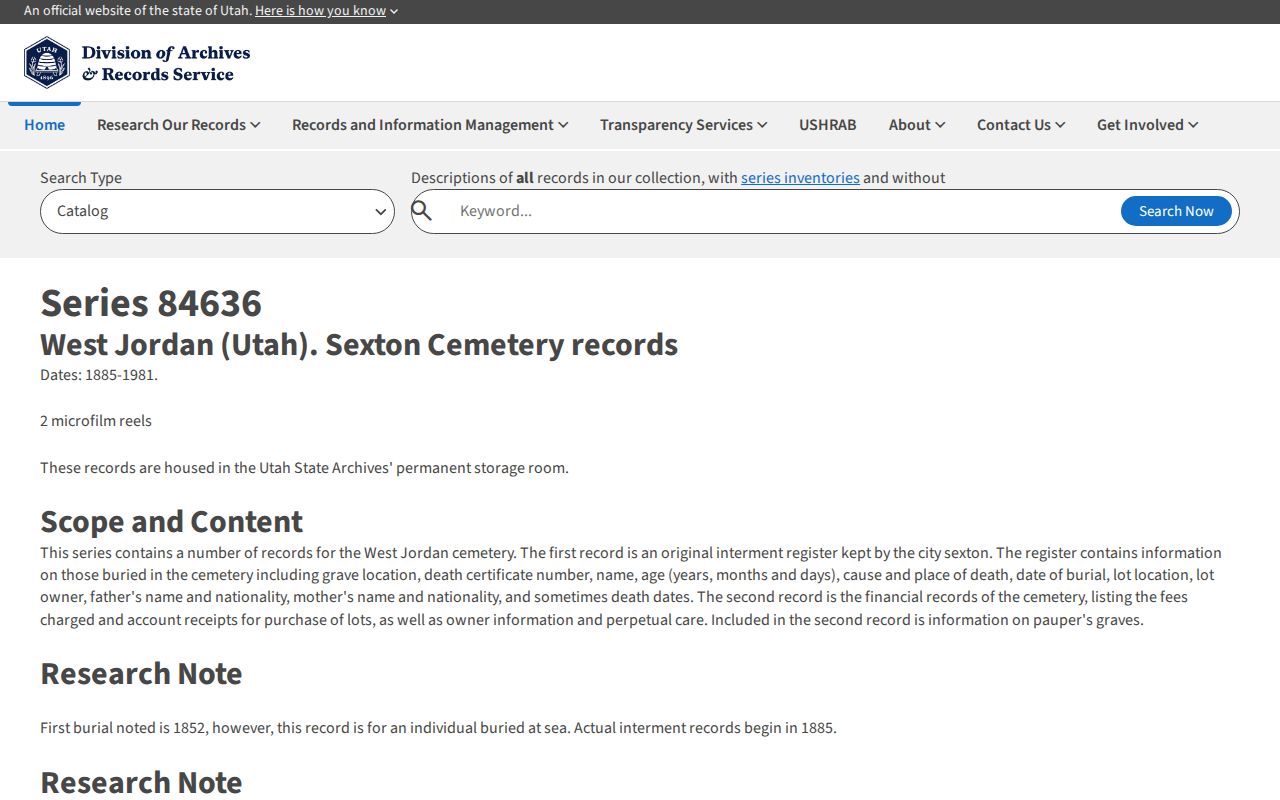
Salt Lake County Archives is the stronger house-history fallback. It holds county records from 1852 forward, including tax appraisal cards, permits, photographs, land certificates, and family-history material. An address can support a house-photo or tax-card search. Appointments and annual reading-room registration apply. The Utah State Archives and the Utah Historical Society library and collections desk offer additional indexes and specialized directory and newspaper help, with access conditions that can change while collections move.
The Salt Lake County Archives describes its house-history and family-history holdings.
West Jordan History Behind the Entries
Early West Jordan records may not use the modern city name. Settlement began in 1849, the Gardner sawmill and 2½-mile millrace followed in 1850, a school opened in 1852, and the area had 361 people in 1853. The town incorporated in 1941, became a third-class city in 1967, and became a first-class city in 2007. A directory search must respect those changing labels. The Historical Society’s Sanborn map update also shows why map coverage and directory coverage should be recorded by year and place.
The local record story is tied to water, mills, agriculture, mining, and sugar. Sugar-beet cultivation began in 1891, a factory was built in 1916, and the factory site was demolished in 2011. Newspapers, business listings, family histories, and regional directories may describe the same person under different community terms.
| Year | West Jordan record context |
|---|---|
| 1849 | Settlement began along the Jordan River. |
| 1850–1852 | The Gardner millrace and sawmill era was followed by a local school. |
| 1941 | West Jordan incorporated as a town. |
| 1967 / 2007 | The city became third-class, then first-class. |
The West Jordan Cemetery page links a burial search and local cemetery contacts.
West Jordan’s Digital Directory Shelf
The Utah City Directories digital collection is arranged as reference books produced through Utah’s urban history. Its description says the books can list residents, streets, businesses, organizations, and institutions in alphabetical or geographic order, with advertisements. FamilySearch’s U.S. City and Business Directories collection is indexed across roughly 1749 to 1990, with person name, occupation, and address fields. The national collection total is not a West Jordan count.
The 1958 suburban Polk scan is especially useful because the title itself names West Jordan and other Salt Lake Valley communities. Search the book image and the index, then record whether the hit came from the name section, avenue guide, residential pages, yellow pages, or classified material. A commercial listing and a person entry are different evidence.
The Utah Historical Society digital collections provide the state’s directory and local-history entry point.
West Jordan Directory Citations
A useful source citation preserves the publisher, volume year, page or image, section, printed locality, and the exact spelling. Note whether a name was found alphabetically or through the address-order pages. Add the search date and a short transcript only after checking the scan. If the page is hard to read, mark the uncertain character rather than silently correcting it.
For a current identity question, a directory hit should lead to a modern custodian. Compare the address with the county Assessor, use the Recorder for ownership, or move to the resident lookup when a court or voter role needs checking. For an old house, pair the directory with census, newspaper, tax-card, permit, cemetery, or probate evidence. A missing year remains a gap, not proof that the person left or died.
West Jordan City Directories for Families
Use a West Jordan city directory as a time-stamped clue, then test it against another source. The directory may show a name, address, and occupation. A census can add household members, ages, birthplace, and relationships. Deeds and tax cards separate an owner from an occupant. Newspapers, obituaries, probate, and cemetery records can explain a move or death. Library access to HeritageQuest can add census and local-history searches when the catalog points to a wider source.
- Find the person in an alphabetical entry, then copy the name, address, occupation, and exact volume citation.
- Search the next available year and note moves, spelling changes, and any break in the regional coverage.
- Use the reverse or pink-page section for the address, then compare other names at the same location.
- Pair the directory year with the nearest released census from 1850 through 1950, allowing for older precinct and ward boundaries.
- Close a historical trail with newspapers, an obituary, West Jordan cemetery material, probate, or County Archives evidence.
Disappearing from a city directory does not identify the reason. The person may have moved, died, changed a name, fallen outside the book’s geography, or simply not appeared in that edition. Preserve uncertainty and do not convert a dated entry into a claim about a living resident.